Our class watched the movie The Bicycle Thief as a quintessential Italian Neo-Realism film. Here is a summary of its basics.
Ideology/ Thematic Goals
The main ideology of this genre of film is the idea of "solidarity", as the importance of the whole community, rather than the importance of one person alone. The article shows this idea when it says that "[...]a focus on collectivity rather than the individual. Solidarity is important, along with an implicit criticism of the status quo." This type of cinema was against the ideas that had prevailed for so long under the rule of Mussolini, "the status quo". Also, it wanted to show a new view on the lives of real Italians, the everyday worker and his or her everyday, normal life, or " [..] an emphasis on real lives." These films were anti-fascist as much of Italy was after the fall of Mussolini, after World War II, or, as the article says, "Unquestionably, their greatest single influence was the anti-Fascism that marked World War II's immediate postwar period."
Historical Context
Again, Italian Neo-Realism emerged after World War II, making "[...] their greatest single influence [...] the anti-Fascism that marked World War II's immediate postwar period." Italy was in very poor condition after World War II; much of the country was in poverty, the government was in shambles and people were trying to rebuild their lives amongst all of this destruction. It makes sense that this movement broke from the idealistic, fanciful portrayal of life in Hollywood movies, for so much of the country was in despair, trying to rebuild. These people were probably disillusioned, and filmmakers wanted to capture this instead of normal escapist cinema.
Cinematic Techniques
-documentary-like style -set up not elaborate -not too complicated shots -not many shot changes per scene (in comparison to now) -used non-professional actors -do not use sets; filmed on-location -simple story
Key Contributors
DeSica: He was the director of The Bicycle Thief and made sure that the movie was shown as a piece of fiction, not as a documentary, but he did make sure to use non-professional actors. He focuses on the masses, not the individual.
Visconte:He made Obsession, and said that he could make a movie"in front of a wall" as long as he had something to say about humans in front of that wall. He liked to keep the movie "real", as in shot in real time and with unprofessional actors. Long takes, complex shots used.
Rossellini: Combined melodrama and actual footage into short bursts of intensity. It was not comforting. Also focused on the senselessness of war.
Important Films
The Bicycle Thief: This movie was important because it used non-professional actors in order to portray the real lives of people in Italy at that time. DeSica made sure to focus on the mass of people in this situation instead of the individual, showing the weakness of one and the power of a group of people behind one.
Obsession: This film used long complex takes to prove its point. affecting other films like this. It dwelled on the shots with bleak, natural light backgrounds.
Open City: This movie had a low budget, so Rossellini had to make a movie that combined the footage they shot as well as melodrama. This made the story episodic, with a jarring narrative.
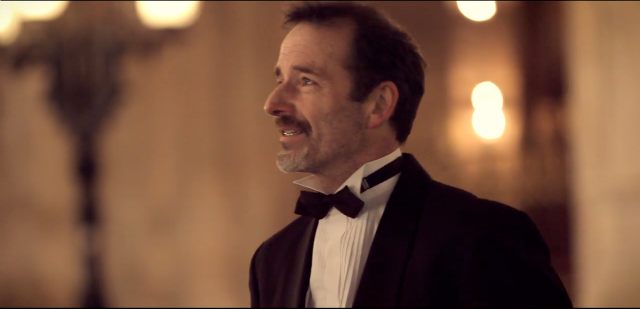
It is interesting to see what just frames from a movie can tell us about the characters and the conflict of the film. Film is a combination of information from audio and video (moving pictures) used to create a feeling and to tell a story of some sort. In the short film "Wrong Place Wrong Time", a man is wrongly captured and then thrown into the ocean to keep the mistake a secret.
At the beginning, we see a guy in a tuxedo trapped in a box, and then we see a flash back to how he got into the box; two brutes ambushed him when he was coming from a high class event and put him in a box to bring to their master.
We can tell by the look on his face in normal conditions that he is a shrewd man of sorts, a person who is probably practical and calm. We can gather this from his dry humor in his lines also, making his acting match the character's personality.
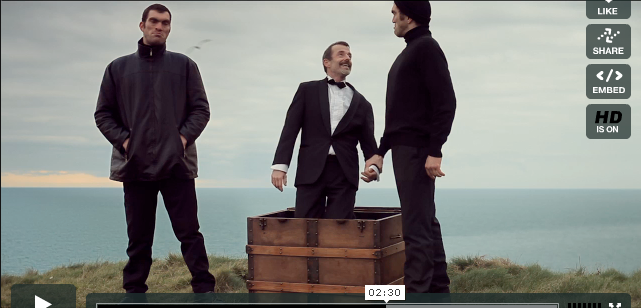
When we reach the climax of the movie, it is easy to tell what the conflict is based on our prior knowledge of such situations with only the video, for the men are by a cliff and the two big guys are impending and would probably kill the man in the tuxedo if they did not get what they desired from the man on the computer. The following still demonstrates this idea:
Clearly, there is an issue, for the two taller men are the more powerful ones in the power relationship, and there is a dangerous and mysterious expanse behind them; the audience nor the protagonist know exactly where the characters are. Again, the tuxedo man is proven to be shrewd because he is trying to persuade his way out of danger, but he is loosing this battle.
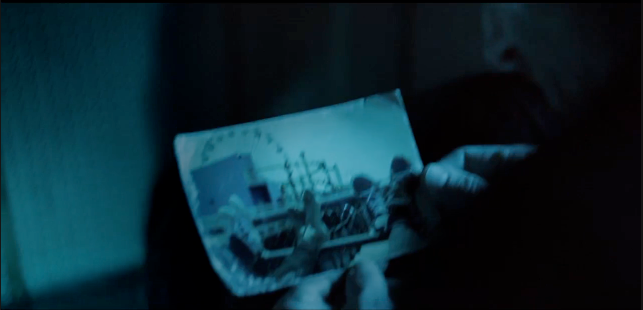
Finally, in the resolution, the man is thrown into the water in the box and he looks at a photo of his while the water is gushing in. This part did not even need words to explain the depressing, hopelessness of the situation, with the man taking one last look at those he has left behind and will probably never be able to see again and at happier times in a photo probably of him and his friends, as shown:
This scene is blue with the water all around the man, depicting the hopeless mood well, and the picture is blue in this situation too, for the man is sad that he will never be able to have happy times like that and that he will probably die. The frame shows that the man has now resigned himself to his fate and wants to die remembering a happy memory. All of this can be shown through the pictures alone.
Overall, images can have just as much, or even more, of a message than words can in film, depending on the film. Images affect the power of a film significantly, for they are a main component; this can be the difference between and great, okay and horrible films.
This film created very interesting effects with lighting, lighting up certain parts of the shot more than others and using interesting blur transitions.
An example of interesting blurring of the lights is at the beginning
The shot starts off with both of the characters in an embrace in lighting focuses solely on them, making them stick out from the back ground of bridge lights. Then the focus fades out slowly, taking away that effect. The lighting was really nice and professional looking, and it really emphasized the couple and their intimacy from the beginning of the movie. It also set up their urban environment, making their relationship appear chic and appealing. The focus fade sort of shows how the man is now out of that dream world, back to the normal world.
The lighting that is placed on the flowers is really rich and "sunny" in comparison to the background of pitch black. This is a very nice effect, because the stark contrast makes the viewer focus on the light part and understand how the man is yearning to come from the darkness into the "shiny" part of the night time with the woman in the "shiny" dress.
The effects of the lighting on the cityscape are also amazing, especially in this picture, for the man has a very nice lighting on him that makes him stick out from the city at dusk, but the city is not totally in the dark either, for, though it is not in focus, it is still partially lighted and has a nice contrast to the man. Again, the focus on the man against the city adds a nice cosmopolitan, chic image to the film.
I think that both stories fit, for they emphasized the concepts pretty well. The cowboy scene, originating from The Good, the Bad and the Ugly film from 1966, is a classic example of long shot durations and short shot durations all in one. The axis match piece placed the two characters on opposite ends, with the tension building with each shot getting closer, and this of course showed axis match used to tell a story more intensely. I think that we did a good job portraying both concepts, but the Axis Match one is not as obvious as the shot duration one, for the shots that are on the same axis on the same shots are not usually directly after each other to show the idea as strong as possible because of the story involved, but there is still axis match in the way that shot is one the same axis for each actor despite the shots switching between the actors.
2. Camera Work
We shot the characters well most of the time, but the camera was probably not as steady as it should have been, sometimes changing the shot. Some of the challenges were trying to keep the axis correct because the camera kept moving each time we moved the tripod, so it left an unsteady shot. Also, it was hard to keep the same angle on the cowgirls in the shot duration piece, because they were at different heights and it was hard to visualize the same angle on their faces for both, so that neither looked bigger or smaller than the other. It ended up that Dazzy still looked a bit smaller than Nellie, making their power relationship unequal, but it worked out because Dazzy lost in the end of the fight anyways. The best shot was probably the pan in the shot duration piece, becasue it really showed how intense the scene between the two cowgirls was, but it could have been a bit shorter. It is very tense, a bit like a cowboy movie.
3. Edit
Some of the challenges I had in the edit were trying the keep the shots matching, because either way there was a lot of cutting between two characters in a conflict. I had to cut a lot of shots at the right time so that there would not be any jump cuts. In the axis match, I had to make sure that the characters and the camera were in the closest position to being the same as the last shot. Overall, the edit was not too hard, just a lot of cutting and putting the right shots in the right places, to create the correct power relationship between characters and to make sure the topic was being demonstrated clearly. In the shot duration, I just had to find matching shots, and switch between them at the right intervals to show either long or shot duration. In the axis match, I just had to cut with increasing closeness to each character as tension increased, then backing up at the resolution, but I had to cut some shots with bad lighting, but it still worked.
Overall, I thought that this trailer was very well done for a student film. They knew how to draw people into the situation effectively with music and mis en scene especially. I really liked how they protrayed the lonely atmosphere in several different (though at times over-used) ways. They effectively built up to the action scenes and "kept us guessing" about what the whole situation is, while using appropriate music for the fearful and grave tone. Unfortunately, I must say that it was a bit cliche, and we have all probably seen traces of this plot and such in other movies. Still, it look professional enough to be a Sy-Fy Original movie; that is pretty good for a student trailer!
Mis en Scene Throughout this trailer, I noticed that my eyes were attracted to the people in the shots, for often there were few or no people in the shot, emphasizing the sparceness of the evnvironment and the resulting lonely and fearful feelings of the characters.
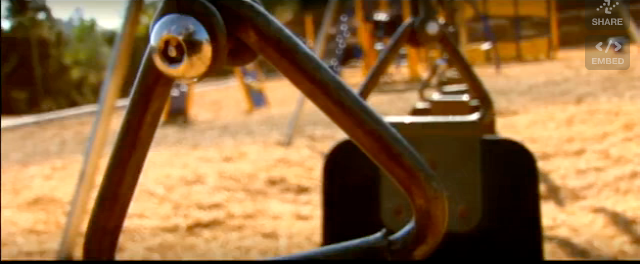
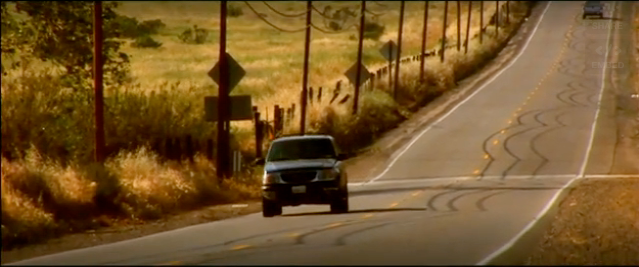
The lighting is mainly low key, for this is a horror film, and the low key light like when they are discovering the situation in the house makes it seem creepier. There does not seem to be much high contrast, for a lot of it is just showing dark places and empty places in the daytime. The camera is usually in a sort of neutral postion to keep the audience on level with the characters. The camera is generally reasonably close to the action, though sometimes it goes far off to show the situation. The color values are either very dull or dark to show that there is something wrong going on in the area, to create a dark mood to create mystery. The eyes usally stop on the other people in the cackground, or the furthest line away, like the outer line on the highway. The visual background is somewhat stark, with plain beackgrounds, such as in a house or on the road, but with a sense of depth created through blocking, such as with the swing sets all going back to create depth, or the group of kids standing around a bit away from the foreground person.
The balance isn't not always there with the depth, though; sometimes the kids in the house shot are not angled correctly in order to create a more meaningful and interesting shot. The framing is loose in the opening scences to emphasize the sparseness that is integral to the plot, but it gets tighter around the characters once the horror part of the movie starts. It also blurs focus a bit to disorient and intrest the viewer. It is not cut ojectively, for the viewer is manipulated to feel the lonaly feeling the editor wants us to feel. Editing is a
Editing
There is a reasonable amoung of cutting, usually fadining into black each time, but the cutting is not extemely fast, showing different views to emphasize the intrigue and setting but not cutting to fast so that there would be a bit of tension created with the longer shots. The cutting is somewhat manipulative, for it places emphasis on the creepy loneliness throughout the piece. The rythym basically shows showthing interesting, they starts speaking, then while speaking it fades into another image. It is not cut ojectively, for the viewer is manipulated to feel the lonely feeling the editor wants us to feel. Editing is a language in this, since it is a trailer especially, for it shows us the feeling that the editor wants us to feel, especially since it is just putting the most interesting teaser parts together randomly to interest the viewer. It has sort of a sequence shot, for it is put in this order in order to interest the viewer.
Motion Analysis
The director does keep the camera close to the action for parts, especially when the tension is higher, but leading up to that the camera is a bit father away and the action is much more slowmoving, in order to create suspense. An example is when the boy is in long shot and comes closer up through fading in; this is not close, and is used to create suspense. The slow motion parts show good times, before the group found out about all of the disappearances. The movement is somewhat dramatic, with the slow and hesitant nature of all of the characters. The trailer starts with the camera being far from the action with the car, and getting closer as more intesity builds, like during the horror sceens. They frame these shots well, keeping the rule of thirds and such in mind.
Sound Analysis
The sound is generally innocent and not jaring at first, but it gradually it pounds and pulsates to create a forboding feeling. The sound is distorted a bit in order to make it sound more haunting during the jarring part. It is not very complex, and not much symbolism; perhaps the beinging music is symbolic of the innocence of the characters at the beginning. The motifs my be the road and the swings, for they represent abnormal sparseness. The sound often uses piano, deep drums of some sort (probably distorted), and synths. Music is often used to emphasisze language in this piece, making it sound more foreboding, ominous.
1. The challenges that Cameron had were that when Cameron first thought of this movie about fifteen years ago was that the technology at that time could not actualize this film up to Cameron's expectations. Cameron knew that technology at that time would not look realistic and believable in creating the world of Pandora, integrating human and CG characters in a believable fashion. It seems that Cameron wanted to have this combination of CG and humans as a main part of the film to show more emotion, and especially wanted to show believable human emotion in the CG. Back in the 1990s, the time of the original concept, only animation could create somewhat convincing imaginary characters, but that would not mesh well with live action and animation for the entire movie would cause a great loss in audience. Cameron wanted technology that could bring the digital characters to life the same visual emotion and movement that had never been done before, integrating the actors into the visuals. Cameron needed to create his own technology to show hi-resolution compostitng, showing the background images with the characters in CG forms. Also, he had to develop technology that could capture the intricacies of the human expression and movement to show how very connected humans and Navi are even though they look differently; this could not be done with older fashioned CGI. Also, an issue involved in creating all of this technology is getting the funding to create it; Cameron had to find investers who were willing to invest a lot of money on a project that could fail, despite all of the money that went into it; this movie was a risk.
2. It was created by integrating much of know science and the state of today's society into the movie's world of Pandora. They used a solar system that was relatively close to ours to make the trip seem not all that improbable, even making the characters sleep cryogenically for five years. It seems that the creators of Pandora's attributes wanted it to be very different from earth, so that the similarities in behavior was accented in making the audience sympathetic with these very different humanoids. Even, it seems that they modeled much of Pandora after a prehistoric type of Earth, with pterodactyl-type birds and lush, green landscapes. This sort of shows how this world is pure, untouched by the greed that is not a part of Pandoran life, but can be in Earth life. They seemed to make it clear that Pandorans are symbiotically connected to their planet and that they knew that hurting it would be hurting themselves, not like humans. The air that humans cannot breathe makes Pandora a dangerous place for humans, showing how humans will risk their lives at times in greed, for unobtainium. Humans are clearly not welcomed by the atmosphere itself; they are only there to get what they want, not to develop relations with the Naa' vi. Pandora's name itself seems to be particular chosen to allude to the myth that a woman named Pandora was curious about a box she was told not to open, and thus unleashed all of the bad events and feelings into the world. Humans have entered Pandora, and have unleashed many problems onto themselves and the Naa' vi.
3. Performance capture is a lot more personal than motion capture is. Motion capture shows the general movement of a character in a moment, but does not connect the dialogue and the motion very well, not showing the subtlties of the performance as a whole. Performance capture, as in this movie, basically transforms an actor's performance into a digital character, as if that digital character is actually acting the scene. The dialgue and the movements are all in one in performance capture, creating a more realistic and well-acted chracter, unlike the separation of motion capture that distances one from the character and does not catch the same minute expressions in the face and such as performance capture does.
4. $150 million were spent on advertising this movie, consider to be a collassal amount. Some of the issues that News Corp has had in funding this movie was that its a big risk due to its huge pricetag; if this movie had flopped, it would hurt the company hugely. A considerable part of the initial money coming in from the movie tickets goes to the movie theatres, but the company can still make money from the rest of the ticket, DVD sales and merchandise. Also, part of the money has to go back to the investors. Another issue with the movie involves illegal reproductions, and cheeap rentals. News Corp is already weakened by the lack of newspaper advertisements in its main publications. The cost of the movie probably has, in my opinion, influenced the story of the movie; it has a common basic story that is proven to work through other movies like Pocahantas and such. Since this movie cost so much, the producers wanted a story that was proven to work, that was proven to make money, in order to reduce the risk of this movie flopping with so much money invested in it. It could not risk a story that might not work, for then all of that money would have been for no money in return.
5. I think that saying that the movie "identifies the profound spiritual bankruptcy that underlies our financial insolvency...and reminds us (to)... make new choices for the greatest good of all" is a slight bit of an overstatment, for the movie does show us effectively how trying to exploit the world for all that it is worth will only hurt a civilization; the Na'vi know this in contrast to the humans who hurt the Na'vi and themsleves in the process of exploiting Pandora's minerals. This is shown by the way that the Na'vi and humans both lost many lives and a part of their plans in the process of this movie; for the Na'vi their tree, for the humans their unobtainium. Even so, I think that since this plot is simmilar to movies in the past, it can only bring so much new insight into the topic of "spiritual bankruptcy" and "making new choices for the greater good". Avatar is limited by its cliches for since it is so simmilar to other plots, there is nothing that "sticks out" in particular about demonstating the themes, so the themes are not as memorable, in my opinion. An example of this is how Sully says "This is our land" after he has conquered the Turok and is calling the Na'vi to trust in him and work together to defeat the humans. This moment would be very touching if it had not been done in 300 ("This is Sparta!") as well as other movies; the issue is that this empowering call for union and trust to do what is right loses its power because it has been heard too many times before.
Also, as for there being a racist subtext, I think that is not really applied to this movie; yes, this movie does involve numerous white Americans going over and conquering a group of different looking people to exploit the land, but the movie is proving that this exploitation is wrong, that this is how people shouold not act in general. The Na'vi are portrayed as a relatively peaceful group of people who only fight because their land is in danger; this happens even between groups of people who look the same, such as the fights between Germany and France over Alsace-Loirrainne. Even so, that is not the point; this movie shows more how it is wrong to exploit a group of people for your needs, not considering theirs. It may be stereotypical, more so than completely racist, that the Na'vi are very tribal and based off of black actors, for often when Americans think of people being conquered, it is usually people of another race, as far as Western society goes. Of course, it makes sense that these people are tribal, for if they had had advanced technology, it would have been easier to defeat the powerful humans and their battleships. Also, these people are more connected to the land, like tribal people are generally attributed to be, more effectively showing the theme of the unbreakable connection between one and their environment. The only slightly racist thing may be that all the Na'vi had black actors and most of the humans were white; this is stereotypical, but I suppose the director used a bit of this physical difference between the actors just to further show how like blacks and whites, Na'vi and humans should treat each other more equally.
My group's film was called "Nothing Personal". At first, we all worked together to create an original script using ideas we had from our own treatments. This original treatment/script had basically the same phone call that we had in the final version, but instead this one lead to the girl friend getting killed as the boyfriend went to save her after originally betraying her. This script was a bit too cliched, so we changed it around a lot, but its central themes were still tied to betrayal and unfairness. We made it so that the audience would be much less sympathetic with the boyfriend, John, than in the original version. We did this by having the boyfriend not save the girl in the end and just have him watch as she gets taken away. This improved the script a lot and we worked well together, putting all of our ideas into one project, which is nice.
After we revised the script, we went on to make the two column script and location diagrams. We split up the work 2 and 2 once we got the first scene finished; Crystal Dwyer and I worked on the shots, Crystal Ding and Vincent worked on the first location diagram. I think that this worked out reasonably well, for I got to contribute a lot to the shot description, but it was not as much of a group decision as the script. It would haven been better if the other 2 had more input. Also, we ended up having to change the shots we had during production later because these shots did not work out as well as we wanted them to, so next time we can learn about how to plan the shots more realistically.
I also had to make the location diagram for the longer scene, because I knew the area the best.
After we finished all of the pre-production, I had less of a role in the actual production; I just helped out with sound and shot continuity. Crystal Dwyer was the camera opp for the whole time pretty much and Vincent acted, while Crystal Ding and I worked on the sound and shot continuity.
In retrospect, I probably should have advocated for more use of the tripod, for looking at the shots now, especially towards the end, they are a little bit too shaky and raw looking. At points, we sort of wanted it to look that way, to create a sense of chaos and uncertainty, but it appeared sort of silly at more basic shots, such as the close ups. Also, it was a problem that we did not take the 180 degree line into more account, for we actually broke it in the beginning of the main scene. I was able to edit this out in my version of the film, because the shot was not necessary, but it did take away from some of the dramatic tension after being edited out. Maybe we rushed the production slightly much during the main part of the film in the dark area, for it was getting late and our parents wanted us home, so some of the shots may have suffered, and one or two complicated shots were omitted in interest of time and reality.
Of course, I had to edit my own version, so I contributed to that almost entirely. Editing the project was hard because of some sound issues, placing the clips in the most effective order, managing the time spent in each scene, and the 180 degree line. This shot transitions into almost an issue with the 180 degree line. The sound of the machine varies from clip to clip, even if they are supposed to be at the same time, so this is sort of distracting, but I used music to take away from the machine's sound. Also, putting the clips in a nice order and keeping time were connected, for I did not want to spend too much time on the "meanwhile John was walking" part during one part of the dialogue between Dick and Maria. Another edit that I tried was to fix a lighting experiment that we tried, where the lighting in a nice establishing shot was too different from the rest; I put a red tint on it in order to make it seem more cohesive with the rest of the shots. Obvious difference in color; is improved to have red tint, though maybe slightly strong. Other than this edit, I just had issues trying to make the clips come together in a smooth manner.
Evaluation as a Whole: Film Critic Style A. Casting
All of the actors appear to fit their characters reasonably well, for Maria (the girl) looks sweet and innocent, while the two main male actors appear a bit more impending and suspicious. Maria definitely has a different personality from the two males, but both of the males seem to have more similar, evil characteristics. Even so, their personalities are different enough, for Dick the drug dealer seems to be more cocky and not regrettful of the bad things he does, while John is slightly more regretful, but is more of a person who uses girls, or a "player". The actors did act their parts well, but sometimes Dick (the drug dealer) was a little too cheesy, and Maria may not have put the right type of inflection on her lines, but they were convincing enough. John was really good most of the time, for he was just the right amount of caring and not caring about Maria. Also, all of the characters have distinct appearances, so it is hard to mix them up. The extra gangsters work out fine; they do their parts well and seem impending enough.
B. Acting
Sometimes the acting is slightly cheesy, but I do think that the audience will feel sorry for Maria and completely dislike John, for they are convincing enough and their dialogue is acted out emotionally. The actors do generally absorb themselves into their role, all three of them, though Dick did seem to translate some of his normal mannerisms into his character. All of the lines are clearly spoken, though sometimes the machine in the background hindered their clarity a little. The edit fixed some of these issues, but the machine sound was still evident. Towards the end, the actors were a bit tired, so I think that John's lines could have been delivered more convincingly, but Maria was generally "energetic" the whole time and Dick stayed in the same character throughout. The actors were nice off the camera, too. They came even though we had to change the filming time on short notice and were only off task sometimes. (They listened to our directions and were patient.)
Exemplary Acting by Dick
C. Script
The lines are always appropriate to the situation, and they never say too much. A lot of stuff is implied, such as what is in the bag and what Dick will do to Maria in the car, so we show rather than say everything. The lines are customized to each character, for they are in all different positions in the situation, and have different personalities. The plot does make sense, though the audience does have to take for granted that Maria could not see John and that she could not open up the door, but these are not too hard to believe and do not really have a place to be explained in the movie. The situation develops from the phone conversation foreshadowing problems with a bag drop off, then a conversation between Maria and Dick where Maria is thrown into the car after learning of John's betrayal, and finally, John comes out of the shadows and talks to Dick about his debt and calls a new girl friend to do his dirty work for him. This shows a conflict: did John really betray Maria, or will he save her? Then it has a resolution: No, John will not save Maria, he knew of the plan all along, and he plans to do something similar to another girl.
D. Wardrobe and Make-up
The outfits do fit the characters, for the guys look rough with their dark colored clothes and Maria looks sweet, even though she is wearing dark clothes also. The time period is the present, so their clothes fit the time period and their ages well. The colors are dark and muted, and generally go with the dark themes of film noir, but the labels were a bit of a problem with the male characters, for they were slightly distracting. The colors of the clothing separate themselves enough from the wall and the darkness, and are complemented by the warm lighting. The make up does not really apply, for the male characters did not use any, and there did not seem to be any issues with Maria in the variety of shots. Label issues
E. Music and Effects
The music does not really distract from the dialogue, for it is low enough to be played in the background and is usually during non-dialogue shots. The music is dark and foreboding, fitting the general mood of the film. It is more modern sounding with electrical pianos and such than a traditional noir film, but this is fine, for the film takes place in current times, and can benefit from more contemporary, edgy music. Sometimes there is too much sound track, but it is meant to overshadow the background ambienceThe voices were originally a little overshadowed the at times, but it has been mostly fixed. F. Staging, Props, Mis en Scene
The set design is supposed to look edgy and urban, to set a dark and chaotic tone. We created this set by making John's room look messy and edgy, to show how he is not the "perfect" boyfriend. This set is not too distracting, for the full extent of the room is only shown for a few seconds while John is not talking, leaving the room. The lighting is fine, though it is a bit too bright and the sound is clear. The second set is very simple; it is just a brick building in front of a parking lot. There is nothing here to distract the viewer, but the environment is not too plain, either. It is rough and violated looking, as if it is part of the urban sprawl, the "underworld" of the city. The lighting is essentially one source and dim, making it the perfect lighting for the scene. The sound was a bit hard to get constant, because of the changing sounds of the machine. The actors always stick out from the set enough, so that is not a problem. There are no problems with the props, for they are all contemporary with the film.
Dark, urban area; an important part of film noir.
Room crowded on purpose to characterize John.
Strange Lighting issues, but violated, rough surface with good lines, perpective, and harsh lighting.
G. Lighting
The lighting was never a problem in the first scene, but the wall scene had some problems, because the lighting with the car lights was colder than the warm lighting of the light above the scene from the wall. This caused consistency problems, but I partially fixed the problem by putting a light red tint on the car lighted scene we used. There is enough lighting to easily distinguish the actions of the characters and a sense of depth and the lighting fits the time of day, for it is at night for the most part, and the first scene takes place near night time, so it makes sense. The dim lighting worked well for the wall scene; there are very deep shadows, a characteristic of film noir.
Dim, warm lighting on the "crew".
H. Titles and Credits
I think that the titles are characteristic of the film because the main theme contrasted with the elegant writing. The film is raw in comparison the cursive writing. One might expect the titles to be more raw looking, but I like how the titles are simple and elegant, “betraying” the darker themes of the film, and connecting a sense of betrayal in the title itself. The titles appear to remain legible and seen throughout the title and credits; they are not shown too fast to be read, either, so that is not a problem. The titles do not interfere at all with the visuals for they are only shown with a black screen in the background. The titles may be too short and not give credit to those in the film at the beging, but all of this information is given at the end. It is elegant and simple, belying the raw subject of the film. The title fading in; simple, but noir
I. Camera Operation
Sometimes the camera work was a little bit awkward in movement because the camera op did not always use a tripod. In the edit, sometimes the transitions between shots and dialogues were strange because of this, but it normally was not too distracting. We adhered to most of the rules of shooting, but we forgot about the 180 degree line and did not notice that we broke it with one of our shots. In the edit, I was able to omit the original clip that broke the line, but next time, we might not be able to do that, so we need to be more aware of this. Sometimes shots seem to jump around too much, also. 180 degree issues (shown earlier, but demonstrates this point)
J. Sound
The microphone was placed so that the sound would be heard well, and Crystal checked the sound levels when a new character began to speak, so the audio is constant. I needed to change the level of this audio, but that was because I was using the audio from a different shot for a behind-the-characters shot. Sometimes the music is distracting from the dialogue, but I am going to fix that. The only major problem with the sound is that the sound of the machines going in the building are not constant throughout all of the shots, creating some discrepancies in the dialogue. I am working on minimizing this. Other than that, there are no extra noises and the audio is clear.
K. Editing
All of the edits and transitions connect with the subject matter, for they are raw and dark, only using cross dissolve and cross fade; nothing cheesy. I fixed the visual perspectives in the film, so the visual perspective is generally constant, but it may change one time, but that should be all. There are not too many scene changes, and the centers of interest do not seem to change much, though the first shot of the 2nd scene on the wall is further away than the last shot of the first. The shots do show what is happening well, except maybe in the dialogue of Dick and Maria where its is mostly shot as close ups, not in usual dialogue form, meaning there are logical physical statement; what is implied by the dialogue is happening in the scene. The film does follow what people would generally expect to happen shot wise, even in some of the strange dialogue shots. The edits I made try to keep the story going fast, but it was hard to make it go fast in the 1st scene in the bedroom, but otherwise the story is told time efficiently. I paced the "meanwhile" scene so that parts of John walking were seen in between each piece of dialogue so that the film did not spend too much time in between lines on the "meanwhile" walking scene. There does not seem to be any major technical or continuity jumps in the edit, but the edit could flow better, for sometimes the shot transitions are a bit jerky and they say their lines too quickly. The scenes are generally time efficient and get to the "point", but the first scene takes too long to develop.
L. Story Analysis
There is no narrator, for the story tells itself through showing the actions and dialogue of the characters. The implied narrator is essentially John, for the story follows a lot of his actions from his point of view, though this narration switches for a while to show Maria’s point of view during her encounter with Dick. The spectators of the story show how everyone seems to accept the horrible events of the story; it is as if there is no ally for those in need, and if there is, that is not good enough to conquer evil. This idea often appears in film noir like this one. We fill the narrative gaps by assuming what is in the bag (drugs) and what happens to Maria after she is taken by Dick. The time is presented chronologically, but with different shots shown of what is happening at the same time, making the movie classical, The genre is neo-noir, for it is a dark film that shows the raw edge of life and how it is unfair, though it takes place in present time in color. The genres evolution is at the stage where the genre begins to change, though keeping a similar formula. The movie shows how socially the world is a dark place where no one is completely safe with the ones that they love, for they can be betrayed. This film shows the uncertainty of a growingly complex world for teenagers who get involved in the “underworld” of drugs, a relevant issue. The dialogue in this film is very short, but tells the story well enough when accompanied with the images that show what is going on. The film has slightly stylized dialogue to emphasize the unfairness of the situation; John says “Me too.” when Maria tells him that she loves him to emphasize his selfishness. At the end, we can see that he is going to continue to be a horrible person when he asks another girl for a favor. The universal human traits that are shown are anger, hesitation, and fear; we can see all of these traits in Maria. The characters do not articulate themselves much; Maria is the only one that outright says her fear. The other two main characters show their personalities through their actions and indirectly through their words. There are not any direct motifs or anything, except maybe the car as a symbol of entrapment, for that was the place that Maria was trapped because of John’s betrayal. Since this is not really a deep motif/symbol, it does not add much to the film, for it is obviously is when Maria is trapped. The film is told mostly from John’s point of view, though it switches to Maria for the dialogue between Dick and Maria. It is interesting to have John’s point of view most of the time because even from his point of view, the viewer is still not completely sure of his motives. The narrator does not establish much of a rapport because there is no narrator.
M. Ideology
We can tell who the bad guys are because they are implied to be doing things that are not condoned by society and that are obviously immoral. The actors are not all the cliché “bad guy” types, though Maria is a somewhat typical good girl, though she is doing a dirty deed, even if it is out of love and devotion. The two guys do not look all that threatening, but their actions and dialogue show that they have evil intentions. The cinematic themes make sense with the style and ideology of the film because the characters are meant to look like young people late in the 2000s decade in a dark situation; the clothes are contemporary, but are either dark or dull. The characters talk about the same way as other Californian teenagers would. The mise en scene, editing and décor give an urban edge that shows the corrupted, raw truths shown by this film’s ideology. There are no “flashy”, out of place objects or effects; everything is centered on the darkness and corruptness presented in the film, from the dark urban area scene to the fade to black transitions. The protagonist is a spokesperson for the film makers in a way because he shows the opposite of the ideas that the filmmakers seem to condone, for the character John is often shown in a negative light with his dialogue and reactions. The cultural values embodied in this film include the want to trust a boyfriend or girlfriend with each others’ well being, as well as the idea that a romantic relationship should be exclusively between two people; these values are shown by their violation in the movie. The girl in the movie is portrayed very weakly and defenselessly; she does resist her capture violently, but she allows herself to be used and does not try all possible ways of escape. The film does essentially adhere to the genre conventions of film noir and more specifically neo-noir, for it portrays a dark, raw and somewhat realistic situation that does not have a happy ending, in a modern atmosphere in color. The film has a dark, menacing tone that mocks the pure values of Maria, who trusted her shady boyfriend, and reinforces the tainted outlooks that John and Dick had on life.
Connection to Film Noir
I think that our film is definitelyneo-noir, for it has the dark themes of betrayal and entrapment set in a violated, isolated urban area. It shows people at their worst, showing how nasty a person can be when it comes to getting what they want, as shown by John using Maria to save himself from Dick. These humans are deeply flawed, but John is not shown as a completely evil person, because though he used his girlfriend and plans to use another girlfriend, he did have some reservations on his actions at first, as shown by his conversation with Dick. John's redeming qualities are few
John being a total "bad guy" John, the main character, is a multi-faceted character. Maria also changes, too, for she goes from the sweet, easy to manipulate girlfriend to a bitter person fighting for her well being, even though this is only shown by her banging on the windows. Also, we put some of the characteristic "underground dealings" or film noir; this film is all about a conspiracy of sorts, though it is a small scale one invoving the bag, which is implied to be drugs. Dick is shown to smoking a cigarette to add an edge and show his nochalance toward taking Maria.
Also, there is a struggle, which makes the theme darker, evoking a stronger sense of entrapment when Dick's cronies overpower Maria two to one and lock her in a car. The car really does show how she is trapped; she is now in an enclosed space, not in the open air, free. She is also fragile, an important characteristic of film noir; humans are fragile and easily hurt, as Maria is shown to be when she is taken advantage of by John and Dick.
The lighting is dim, and creates harsh shadows that are very characteristic of the dark mood shown in the shots taken in film noir. A dark shot that has a good sense of depth and lighting.
This dark and creepy shot foreshadows the horrible events to come, and transitions well into the next scene, which is dark and outside.
Overall, this film clearly shows film noir characteristics with its moody, but raw and realistic story full of betrayal that strikes deep in the heart. It is set in a dark, urban place that reveals the undeworkings of a corrupted teenage world.